
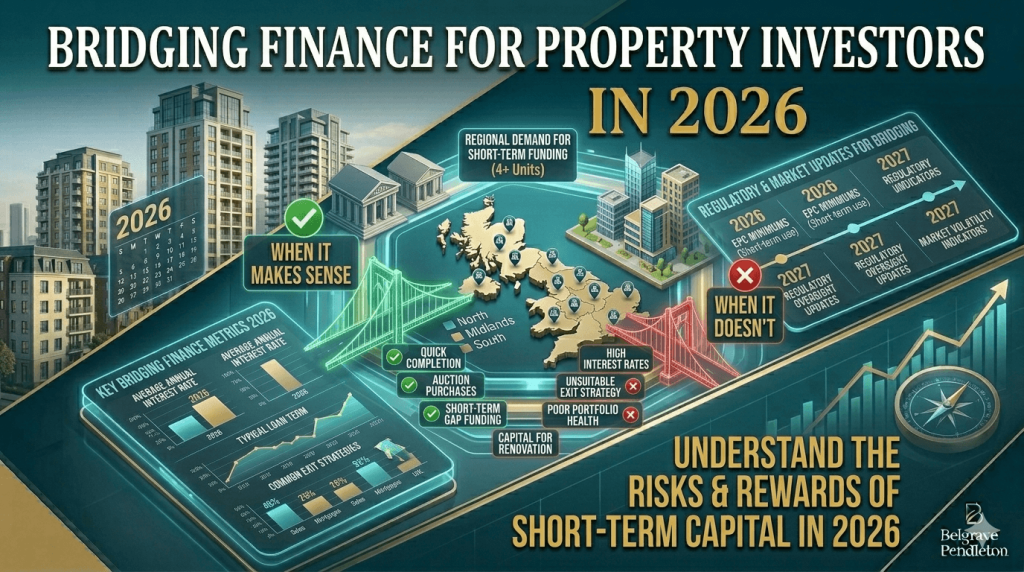
This is a straightforward and honest guide to one of the most misunderstood tools available to property investors.
Bridging finance is frequently surrounded by uncertainty and can leave investors with plenty of questions. While some embrace it as a fundamental strategy, others remain hesitant due to its higher costs and the pressure of short-term repayment. The concept itself is often unclear, and many are unsure when it may be the right solution.
Many individuals remain uncertain about what bridging finance entails or the scenarios in which it proves beneficial. At Belgrave Pendleton, we support a wide range of property investors—from those purchasing their first rental property to seasoned developers. Bridging finance is often discussed with our clients, and we prioritise providing clear, balanced advice about when this option is suitable and when it may not be the right fit.
This post aims to do just that.
What Is Bridging Finance?
Bridging finance is a short-term secured loan, usually lasting from one to twenty-four months, intended to cover a financial gap in a property deal. It is secured against property or land, can be arranged much faster than a standard mortgage, and is mainly assessed based on the property’s value rather than the borrower’s income.
The name itself hints at its purpose. A bridging loan helps you move from your current situation to your next step, such as buying a new property before selling your old one, acquiring a site before getting long-term development finance, or finishing a refurbishment before switching to a buy-to-let mortgage.
Bridging finance usually costs more than a standard mortgage. Interest rates are charged monthly, not yearly, and typically range from about 0.5% to 1.5% per month, depending on the lender, loan-to-value ratio, and your application. You’ll also need to factor in arrangement charges, exit fees, and the cost of property valuations.
However, cost isn’t the only factor to think about. In the right situation, the speed, flexibility, and accessibility of bridging finance can make it the best option.
When Does Bridging Finance Make Sense?
Let’s look at the situations where bridging finance genuinely earns its place in an investor’s toolkit.
Purchasing at Auction
This is one of the most common and convincing reasons property investors use bridging finance, and it’s where the benefits are easiest to see.
Purchasing a property at auction typically requires you to finalise the transaction within 28 days. Standard buy-to-let mortgages often take significantly longer to arrange because of the valuation, underwriting, and legal processes. In contrast, bridging finance can be secured in just days or weeks, making it especially suitable for auction scenarios.
Preparation is crucial for using bridging finance successfully at auctions. It’s best to have a bridging finance agreement in principle before you go, so you know your budget and can act confidently. We help many clients arrange this before they bid.
Breaking a Chain
In a chain of property transactions, delays at any point can put the whole chain at risk. For property investors who need to purchase a new investment property before their existing one has sold, bridging finance can provide the short-term funding needed to complete the new purchase without waiting for the sale to proceed.
In this case, the speed and flexibility of bridging finance can really help, as it prevents you from missing out on a time-sensitive opportunity due to delays. The bridging loan is repaid once your existing property sells, and you can then arrange a longer-term buy-to-let mortgage on the new property if needed.
Refurbishment and Renovation Projects
Many buy-to-let mortgage lenders will not lend on properties in poor condition — for example, those without a functioning kitchen or bathroom, or those requiring significant structural work. This creates a challenge for investors who want to add value through refurbishment before refinancing onto a standard buy-to-let mortgage.
Bridging finance helps solve this problem. You can use it to pay for both buying and refurbishing a property, then repay the loan once the work is done, and you can switch to a standard buy-to-let mortgage. This approach, often called a refurbishment bridge-to-let, is popular with investors who want to build equity and get better long-term mortgage rates on improved properties.
Accurate cost forecasts, a reliable schedule, and a well-defined refinancing plan are all essential. Errors in any of these aspects may lead to significant financial setbacks.
Commercial to Residential Conversions
Turning a commercial property into a residential one, often using Permitted Development Rights, can be a great way to add value. However, this usually needs short-term finance, since standard buy-to-let lenders don’t lend on non-residential properties.
Bridging finance works well here. You can secure it against the commercial property, use it to pay for the conversion, and then repay the loan once the work is finished, and then refinance with a residential buy-to-let or portfolio mortgage.
Time-Sensitive Opportunities
Property investment can move fast. If you find a motivated seller, an off-market deal, or a situation where acting quickly gives you an edge over other buyers, being able to move fast is a real advantage.
Bridging finance can be arranged much faster than a standard mortgage, often within two to four weeks, and sometimes even quicker for simple cases. For investors who are prepared and have a clear exit plan, this speed can mean the difference between getting a deal and missing out on someone else.
Development Projects
For smaller development projects, especially light or medium refurbishments, bridging finance can be a simpler and faster option than full development finance. For bigger or more complex projects, specialist development finance is usually better, but for straightforward refurbishments, a good bridging facility can work very well.
When Does Bridging Finance Not Make Sense?
This side of bridging finance isn’t discussed as often, but it’s just as important as the positive examples.
When You Don’t Have a Clear Exit Strategy
This is the main reason bridging finance can go wrong. A bridging loan is designed as a temporary solution for a specific financial gap. If you do not have a well-defined, achievable plan to repay it—whether through selling or refinancing—it is best to avoid it.
Lenders will ask for your exit strategy as part of the application. Lenders will want to know your exit strategy during the application. Above all, you should have confidence in your own approach. What if your property doesn’t sell as fast as you hope? What if your refurbishment takes longer? What if the refinancing lender changes their rules? These risks are real and happen often. It’s essential to have backup plans and sufficient financial stability for a standard mortgage. For the right situation, that cost is justified by the speed, flexibility or opportunity it enables. But if the additional cost of the bridging finance materially erodes the profit or yield of the investment — and there isn’t a compelling reason why bridging is necessary — it may simply not be the right tool.
Before you commit to bridging finance, carefully work out all the numbers. Include every cost—interest, arrangement fees, exit fees, valuation, and legal costs—and make sure the investment still makes sense after adding everything up.
When a Standard Mortgage Would Do the Job
Sometimes investors choose bridging finance when a standard buy-to-let mortgage would work just as well or even better. If the property is in good shape, there’s no rush, and the purchase is simple, a standard buy-to-let mortgage is usually cheaper and less risky.
Bridging finance serves a unique purpose and is best suited to specific circumstances. If a standard mortgage is appropriate and available, it is usually the preferred choice.
When Your Exit Strategy Relies on Uncertain Assumptions
If you plan to repay the bridging loan by selling the finished property, your exit depends on the property market, which can change unexpectedly. If you plan to refinance into a buy-to-let mortgage, your exit depends on the lending rules in place at that time, which can also change.
This doesn’t mean these exit strategies are wrong—they are the two most common and work well for many investors. However, they should be based on realistic, cautious assumptions, not just on best-case scenarios. If your strategy relies entirely on ideal conditions with no setbacks, it lacks the robustness needed for a reliable exit.
When the Costs Are Being Underestimated
Bridging finance costs can increase quickly, especially if your project takes longer than expected and you need to extend the loan. A common mistake is to calculate costs based only on the shortest possible term, without planning for delays.
Always model your bridging costs based on the maximum. Always estimate your bridging costs using the longest term you might need, and add a buffer just in case. The total interest on a six-month bridge can differ significantly from that on a twelve-month bridge loan.
Before committing to bridging finance, we’d encourage every investor to work through these questions honestly:
- • What is my exit strategy — and is it realistic and credible?
- • What should I do if my exit strategy is delayed beyond my original timeline?
- • Have I modelled all the costs — including interest, fees and legal costs — on a realistic timeline?
- • Is bridging finance genuinely necessary here, or would a standard mortgage work just as well?
- • Do I have sufficient financial resilience if things don’t go to plan?
- • Am I working with a broker who has access to the entire bridging market and can secure the most competitive terms for me?
If you’re able to address each of these questions with certainty, then bridging finance may be a suitable option. If any doubts remain, it’s wise to pause and review your choices before proceeding.
The Role of a Specialist Broker
The bridging finance market is large, varied, and changes quickly. Interest rates, lending criteria, and product offerings can change frequently. Some lenders may not be willing to finance certain property types or work with all kinds of borrowers. The gap between a well-arranged bridging loan and a poorly structured one can significantly impact both costs and the likelihood of a successful outcome. e-of-market access to the bridging finance market — and who understands property investment — gives you a significant advantage. We know which lenders move fastest, which offer the most competitive rates for your specific circumstances and how to structure your application to give it the best chance of success.
We also ensure that bridging finance is the right option for you before we recommend it. Our goal is to find the best fit for your needs, not to put you in a product that doesn’t fit.
The Bottom Line
Bridging finance can be a powerful and useful tool for property investors when it’s used in the right situations, with a clear exit plan and a realistic view of the costs.
It’s a good fit for auction purchases, chain breaks, refurbishments, commercial conversions, and situations where speed matters. It’s less suitable—and can be risky—if your exit plan isn’t solid, the numbers don’t add up, or you’re using it instead of a standard mortgage that would be better for you.
The most important thing is to be fully informed—know the costs, plan your exit carefully, and work with a specialist who can guide you and help you get the best terms.
At Belgrave Pendleton, we help property investors make decisions about bridging finance every day. We’ll give you an honest view of whether bridging is right for you, and if it is, we’ll find you the best terms available across the market.
Get in touch with Belgrave Pendleton today to arrange a free, no-obligation consultation.
Please note: this blog post is intended for general information purposes only and does not constitute financial or legal advice. Bridging finance is a specialist product and carries specific risks. We strongly recommend taking independent professional advice before proceeding with any bridging finance arrangement.