
Property auctions play a dynamic role in the UK investment landscape. They provide opportunities to acquire properties at competitive prices with transparent terms and a definite completion schedule. As of 2026, more investors are taking advantage of these benefits.
However, to move quickly enough to seize these opportunities, your finance needs to be ready before you even step into the room.
Buying at auction comes with a significant challenge that often catches investors off guard: the strict timeline. After winning a bid, the buyer is contractually obligated to complete the purchase within 28 days—no extensions are allowed. Traditional mortgages typically cannot be arranged this quickly, so having finances in place is crucial to avoid losing your deposit or facing potential legal consequences.
Bridging finance addresses this issue. It enables investors who lack immediate full funds to proceed with auction purchases. When planned carefully, bridging loans can form the foundation of a successful property investment strategy.
This guide outlines each stage of the process, from understanding how property auctions function to securing bridging finance, meeting the 28-day completion deadline, and preparing your exit strategy. These insights are drawn from extensive experience supporting investors. The auction sector set a new record in 2026, with total sales reaching £5.87 billion—an increase from £5.5 billion in 2024. Experts from Auction House London and EIG anticipate that annual sales could soon reach 30,000 lots. As the auction market expands rapidly, investors with ready finance are best positioned to succeed. (Source: Essential Information Group, 2026)
Why Auctions Are Attracting More Investors in 2026
The UK property auction market has been growing steadily, and the reasons behind this growth are here to stay. Understanding why auctions are attracting more investors now is the first step in deciding whether this approach is right for you.
Two primary advantages are speed and certainty. In 2026, selling through traditional estate agents can take more than 200 days from listing to final completion. In comparison, auction sales are typically completed within 28 to 56 days, depending on the auction type, and contracts become legally binding the moment the auction ends. This process eliminates the risks of gazumping, broken chains, or extended uncertainty.
The types of properties available at auction also matter. In Q4 2025, unmodernised and vacant properties accounted for 29.9% of all auction lots sold, the highest in five years, according to FD Commercial. These properties often offer the best opportunities for investors, as they are priced to reflect the work needed and can increase in value after refurbishment.
The Renters’ Rights Act, which took full effect on 1 May 2026, is also bringing more properties to auction. According to Property Investor Today in February 2026, landlords leaving the private rented sector are now sending properties straight to auction instead of using estate agents. They prefer the speed and certainty of auctions to the slow pace of private sales. This trend is creating new opportunities for investors who are ready to act.
The data support this trend. NAVA Propertymark reports that auction lots offered nationwide in February 2026 rose by 6.7% year over year, with about 90% sold. The market is active, well-priced properties are selling, and investor demand remains strong.
Traditional Auction vs Modern Method of Auction — Know the Difference
Before you bid, make sure you know which type of auction you are entering. The legal and financial details are different, and mixing them up can be an expensive mistake.
In traditional property auctions, the winning bid immediately forms a binding contract. Contracts are exchanged on the auction day, with a 10% deposit required, and buyers must complete the purchase within 28 days. This approach is typically used for investment properties such as vacant homes, probate sales, repossessions, commercial assets, and land parcels.
The Modern Method of Auction (MMoA) works differently. Often called an online auction, it is more like a conditional sale. If you win, you pay a reservation fee, usually 4% to 4.5% of the sale price, then have 28 days to exchange contracts and another 28 days to complete, for a total of 56 days. This method was partly created to allow mortgage buyers to participate, so the deals may not be as discounted as in traditional auctions. The reservation fee is non-refundable, even if the sale does not go through, so there is still real financial risk.
Experienced property investors seeking below-market-value deals and quick transactions often prefer traditional auctions. For first-time buyers or those interested in more typical properties, the Modern Method of Auction can provide a more relaxed timeline.
Important: No matter which auction format you choose, always read the legal pack before you bid. The pack includes title documents, searches, special sale conditions, and any known defects. Some properties have restrictive covenants, short leases, or structural issues that only appear in the pack. Your solicitor should review it before the auction, not after you have won.
Why Conventional Mortgages Do Not Work at Auction
This is where many first-time auction investors get caught out. They think they can win a lot and then apply for a buy-to-let mortgage, but this approach does not work. Here is why.
A typical buy-to-let mortgage application requires full underwriting, including income checks, credit checks, an independent valuation, an ICR stress test, and legal checks. Even if everything goes well, this process usually takes six to eight weeks from start to finish. The auction deadline is only 28 days.
Some specialist mortgage lenders can process applications faster, but this is rare. Even a small delay, such as a slow valuation, a title question, or late documents, can cause you to miss the deadline. If you do not complete within 28 days, you lose your 10% deposit. For a £300,000 purchase, that means losing £30,000. Some auction contracts also let the seller claim any shortfall if the property later sells for less than your bid.
Bridging finance is designed to solve this problem. A specialist bridging lender can complete the process in 7 to 14 days, which fits well within the auction timeline. Bridging loans are based mainly on the property’s value as security, not your income, so the process is much faster. That speed is the main advantage.
How Bridging Finance for Auction Purchases Works
A bridging loan is a short-term, secured loan designed to bridge the gap between the need for funds now and the arrangement of longer-term finance. For auction purchases, the structure is straightforward: you win the lot, pay the 10% deposit on the day, and the bridging loan funds the remaining 90% balance at completion.
The loan is secured against the property. Terms usually range from one to 24 months, but most auction bridging loans last 6 to 12 months. This gives you time to refurbish the property and then either refinance with a buy-to-let mortgage or sell. Interest is charged monthly and is often added to the loan and paid off at the end, which helps keep your cash flow steady during the refurbishment.
In 2026, bridging loan rates for standard residential investment properties range from about 0.55% to 1.5% per month. The rate depends on your loan-to-value ratio, property type, experience, and exit strategy. For LTVs up to 65%, competitive rates range from 0.55% to 0.65% per month. Arrangement fees are usually 1% to 2% of the loan amount. You will also pay valuation and legal fees for both yourself and the lender.
For example, a £500,000 bridging loan at 0.75% per month over nine months, with a 1.5% arrangement fee and 1% broker fee, would have about £33,750 in interest and £12,500 in fees. That is a total financing cost of around £46,250 before legal costs. You should include these numbers in your deal appraisal from the beginning, not after you have committed.
Most bridging loans for auctions allow a maximum loan-to-value of 70% to 75% of the purchase price. This means you need the 10% auction deposit, plus an additional 15% to 20% in equity or savings. So, you will need about 25% to 30% of the purchase price in cash on the day of the auction, depending on your lender.
Belgrave Pendleton tip: Some bridging lenders will lend based on the property’s post-refurbishment value, known as gross development value (GDV), rather than just the purchase price. This can let you borrow more and free up funds for refurbishment. Not all lenders offer this, and you will need a solid, evidence-based refurbishment plan. Ask your broker if this option is available for your deal.
The Exit Strategy — the Most Important Part of the Whole Deal
Every bridging lender will ask you one main question before agreeing to fund your auction purchase: how will you repay this loan? This is your exit strategy, and it is not just a formality. It is the foundation of the whole transaction.
The two most common exit routes for auction investors in 2026 are refinancing onto a buy-to-let mortgage once the property is refurbished or selling the property at a profit after the works are complete. These two routes account for around 80% of successful bridging loan completions.
If your exit plan is to refinance with a buy-to-let mortgage, the lender will want to see that the property meets standard buy-to-let criteria once the work is complete. This means it must be habitable and lettable, have an EPC rating of at least E (ideally moving towards C for 2028), and generate enough rental income to pass the ICR stress test at remortgage. Getting a mortgage in principle from a buy-to-let lender before you finish the bridging loan is a smart step. It shows your exit is realistic and can help you get a better bridging rate.
If your exit is to sell, the lender will want to understand the property’s current market value post-refurbishment, who the likely buyers are, and how long the sale is expected to take. Specialist or unusual properties — those with a smaller pool of potential buyers — are treated more cautiously because a slow sale extends the bridging term and increases cost.
A weak or unclear exit strategy is the main reason bridging applications fail. Saying ‘I will sell it eventually’ is not enough. A strong exit is ‘I will sell it on the open market within six months at an expected value of £X, based on similar sales in the area.’ Treat your exit plan as seriously as the purchase itself.
Important: Only go to auction with bridging finance if you have already planned a credible exit. If your exit is to refinance with a buy-to-let mortgage, check in advance, before you bid, that both the property and your finances will meet standard mortgage criteria after the work is done. If not, you need to know before the auction, not after.
Step by Step: The Auction Finance Process
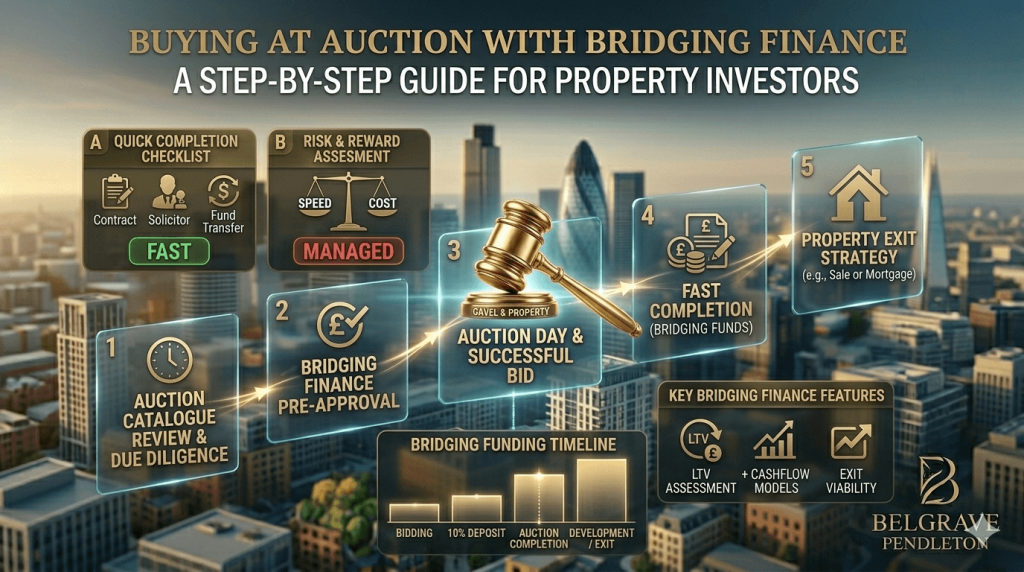
Here is the full process, from deciding to bid to completing your purchase with bridging finance. Follow these steps to be prepared. Skipping any step adds unnecessary risk.
- Download and review the auction catalogue. Identify the lots that interest you and request the legal pack for each one. This is the full set of title documents, searches, and special conditions. It is free to request and essential to read before you bid on anything.
- Hire a solicitor who has experience with auctions. Your solicitor should review the legal pack before auction day, not after. They will look for title defects, unusual covenants, short leases, planning issues, and any conditions that could affect your exit. Make sure to include this cost in your budget.
- Get a Decision in Principle for your bridging finance before you bid. Talk to a whole-of-market broker, ideally one who specialises in bridging and auction finance, and get a Decision in Principle (DIP) from two or three lenders for the auction lot. This will show you how much they will lend, at what rate, and on what terms. Do not bid without this in place.
- Arrange a survey or viewing. Many auction properties can be viewed before the sale. Commission at least a desktop valuation and, where possible, a physical inspection. For properties requiring significant work, get a refurbishment cost estimate from a builder to ground your numbers in reality.
- Set your maximum bid and stick to it. Work out your limit based on the property’s current value, refurbishment costs, bridging and legal costs, stamp duty, and your expected end value or rental yield. Decide your absolute ceiling before you enter the auction. Auction rooms can be emotional places, and investors who get into trouble are usually those who go over their limit.
- Win the lot and pay your 10% deposit. On the day, if your bid wins, you sign the contract immediately and pay the 10% deposit by cheque or bank transfer. The 28-day clock starts now.
- Tell your solicitor and bridging lender right away. As soon as you win the auction, even before you get the keys, let them know so the formal application process can start. Every day counts at this stage.
- Once the bridging process is complete, you own the property. Your bridging lender will appoint their own valuer and solicitor. After valuation and legal work are completed, the funds are released, and the purchase is completed. For a prepared investor with a strong application, this usually happens within 7 to 14 days after the auction.
- Refurbish the property, then follow your exit plan. Once you own it, complete the refurbishment as planned and within budget. Then either refinance with a buy-to-let mortgage or sell, depending on your chosen exit strategy.
Traditional Auction vs Modern Method: A Quick Comparison
Traditional Auction Modern Method (MMoA)
Completion timeline: 28 days from hammer fall, 28 days to exchange, + 28 days to complete (56 days total)
Legal commitment Immediate — contracts exchange on the day Conditional — reservation fee paid, then 28 days to exchange
Deposit/fee on the day 10% deposit (non-refundable), Reservation fee ~4–4.5% (non-refundable)
Finance required Bridging finance or cash Bridging finance, mortgage, or cash
Typical stock: unmodernised, vacant, repossessions, commercial. Wider range, including more conventional residential
Price vs market value: often below market value, closer to market value
Best suited for Experienced investors seeking value, first-time auction buyers, or conventional purchases
What Makes a Strong Auction Finance Application
Not all bridging applications are treated the same. Lenders price risk — and investors who present well-prepared applications secure better rates and face fewer delays. Here is what makes the difference.
• A clear, credible exit strategy with evidence. As we covered above, this is the most scrutinised element of any bridging application. The clearer and more evidenced your exit — comparable sold prices, a mortgage in principle from a buy-to-let lender, or an agent’s refurbishment valuation — the better your terms.
• Investor experience. Lenders treat experienced investors more favourably than first-time buyers. If this is your first auction purchase, be honest about that — and make sure the rest of your application is particularly strong. Some lenders specifically cater to first-time investors; others prefer experience. Your broker will know which is which.
• A realistic refurbishment budget. If the property needs work, lenders want to see a credible, costed plan — not a rough estimate. Get at least one builder’s quote before you apply. Unrealistic cost estimates are a red flag.
• Clean title on the property. Title defects, short leases, or complex ownership histories can slow or block a bridging application. This is another reason why having your solicitor review the legal pack before the auction is essential, not optional.
• Your overall financial position. While bridging is primarily asset-led, lenders still consider your personal financial position — your income, credit history, and existing commitments. A clean credit history and demonstrable income help.
Belgrave Pendleton tip: Work with a whole-of-market broker who specialises in both bridging and buy-to-let mortgage finance. The best results often come when the same adviser arranges both your bridging loan and your exit mortgage, so your deal is structured properly from the start. This helps you avoid finding out later that your bridging exit does not fit your mortgage plans. That is how we work at Belgrave Pendleton.
Is Auction Buying with Bridging Finance Right for You?
Buying at auction with bridging finance is not suitable for every investor. It takes preparation, financial confidence, and a clear plan. But for those who do the work upfront—reviewing the legal pack, arranging finance in advance, calculating all costs, and planning a realistic exit—it opens up opportunities you will not find through estate agents.
The properties found in auction catalogues—vacant, unmodernised, and below market value—are the ones that can create real equity when you buy. Investors who purchase these, professionally refurbish them, and then either keep them or sell them with a clear plan are often the most active and successful landlords and developers we see.
The auction market in 2026 is expanding. More properties are available as landlords leave under the Renters’ Rights Act. Competition is strong but manageable for well-prepared buyers. When used properly, bridging finance gives you the speed to compete with cash buyers.
If you are considering your first auction purchase, or if you have bought at auction before and want to make sure your finances are set up properly, we would be happy to talk with you.
At Belgrave Pendleton, we work only with property investors. We know the auction, bridging finance, and buy-to-let mortgage markets, and we structure deals that connect all three smoothly. If you are planning to buy at auction, talk to us before you bid. The conversation is free and could save you a lot. Contact us today.